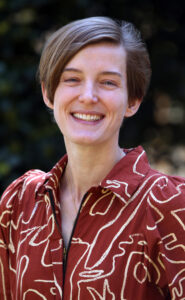
My name is Suzanne van Geuns and I am an Assistant Professor of Religion and Technology at the University of Wisconsin, Madison. Before joining the faculty at the University of Wisconsin, I was a Postdoctoral Research Associate at Princeton’s Center for Culture, Society and Religion. My research interests are in American religion and artificial intelligence, with a focus on sexual ethics. I am passionate about public scholarship and have a particular interest in editing that allows academic research to gain traction in wider conversations.
My book, Computational Creep: Sex and Success in the Intelligence Age, is a genealogy of misogynist frustration and an inquiry into our shared computational condition. It is also a history of online seduction advice, assembling an archive that runs from scattered bulletin board systems in the 1980s to consolidated social media platforms in the 2010s, or from the pick-up artist to the incell mass shooter. Computational creep describes how the language and logics associated with artificial intelligence seep into seemingly non-computational domains, such as sex and romance. Over the course of forty years, paradigm changes in seduction advice kept pace with paradigm changes in artificial intelligence research: cybernetic diagrams recast as feedback loops that prevent her from leaving a conversation, symbolic AI algorithms translated to if/then scripts for initiating physical touch, and the vivid imagination of machine learning algorithms in women’s brains, processing men’s “face metrics.” When users imagine themselves improving their social intelligence, they reach for the language and logics of artificial intelligence. The manosphere is one place to see what it is like to live in the intelligence age. My book is under contract with the University of Chicago Press and will appear in its Class 200 series.
Before I came to Princeton, I was a graduate student in the University of Toronto’s Department for the Study of Religion, and before Toronto, I studied literature at Utrecht University. While at the University of Toronto, I was a Graduate Fellow in the Ethics of AI Lab and at the Schwarz Reisman Institute for Technology and Society. In 2018, I spent a term as a Recognised Visiting Fellow at the Oxford Internet Institute. At Princeton, I developed the Does Not Compute toolkit for online historical research, in response to the questions about method – “how did you find this?” – that often followed my presentations. While my focus is on Computational Creep for the foreseeable future, I am growing excited about a second project focused on fate and/as predictability in the history of online dating and in romance novels.
I can be reached at vangeuns AT wisc.edu